
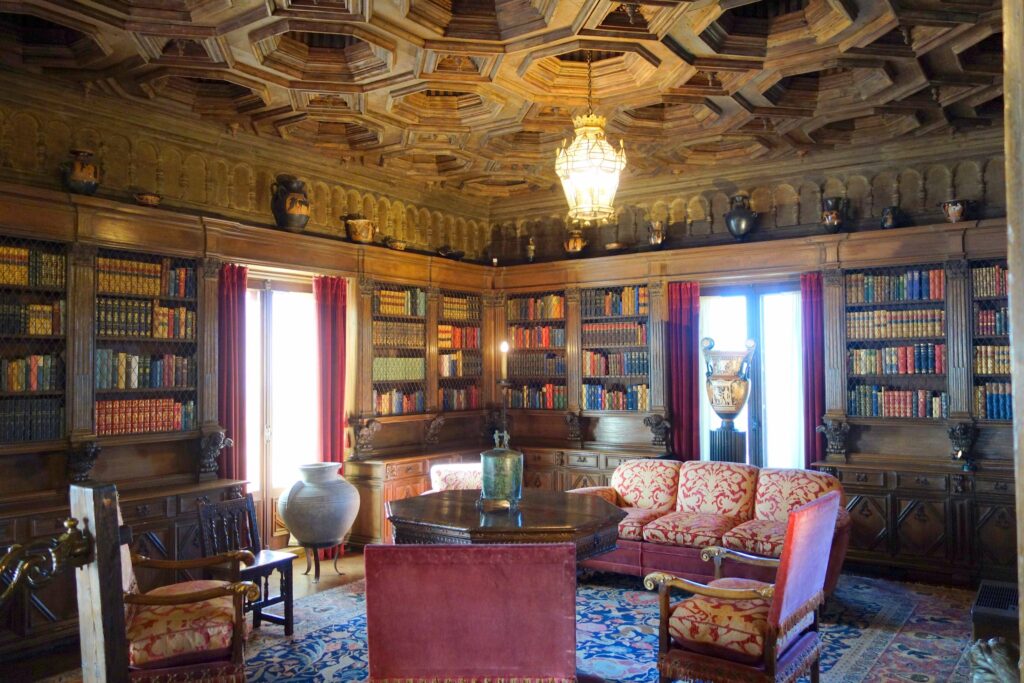
Few figures in the history of collecting provoke as much polarized commentary as William Randolph Hearst, the larger-than-life American media baron whose appetite for art and antiquities reshaped museum holdings and defined early 20th-century collecting in the United States.
By the 1930s, Hearst—founder of the vast Hearst publishing empire—owned an estimated 25,000 artworks, ranging from European tapestries and Renaissance furniture to Spanish ceilings, Greek vases, and Gothic sculptures. His collecting was not only prolific but encyclopedic in ambition. He didn’t just acquire art; he absorbed cultures, rooms, and architectural fragments.
Critics often labeled him a hoarder, fueled by tales of entire shiploads of antiquities arriving at warehouses he never unpacked.
Yet such characterizations often ignore context. The early 20th century was an age of aggressive collecting, with figures like Henry Clay Frick, J.P. Morgan, and Isabella Stewart Gardner also amassing vast European works, many of which now form the core of America’s leading public institutions. Hearst’s purchases were not whimsical; they were deeply researched, often guided by scholars and dealers of the time. He maintained relationships with institutions like the Metropolitan Museum of Art and LACMA, where many of his once-private holdings now reside.
At the heart of this debate lies a key distinction: collecting for ego versus collecting for posterity.
Hearst Castle in San Simeon—designed by architect Julia Morgan and now operated by the State of California—stands as a testament to his vision: a synthesis of architectural preservation, personal taste, and cultural spectacle. While critics argue the castle is theatrical pastiche, others see it as a rare instance of transatlantic artistic memory made tangible.
In truth, Hearst’s collecting habits disrupted the conventions of both aristocratic taste and institutional control. He bought across categories, continents, and centuries—not for resale, but for narrative. His archives show a deep fascination with storytelling through objects, aligning with his work in visual culture, both on page and in space.
Today, much of what he collected has been absorbed into museum inventories across the U.S., including the Cincinnati Art Museum, The Cloisters, and LACMA, often forming the backbone of their European decorative arts and antiquities collections. Without Hearst’s voracious acquisitions—particularly during Europe’s interwar economic collapse—many artifacts may have vanished into private hands or been destroyed.
Hearst’s approach to collecting was rooted in an expansive vision—one that sought not merely to acquire, but to construct a comprehensive cultural archive through objects. His choices reflected intellectual curiosity, a passion for architectural preservation, and a desire to narrate history through space and material.
In a time when art collecting was still emerging as a form of American cultural identity, Hearst gave shape, scale, and serious momentum to the practice, leaving behind not just warehouses of objects but an undeniable legacy in how art moves, lives, and survives.
Links
https://npg.si.edu/blog/hearstory-william-randolph-hearst-1863%E2%80%931951
https://digitalcommons.liu.edu/post_hearst/
https://about.jstor.org/blog/the-curious-case-of-collector-hearst-new-selections-now-available-from-the-william-randolph-hearst-archive/