
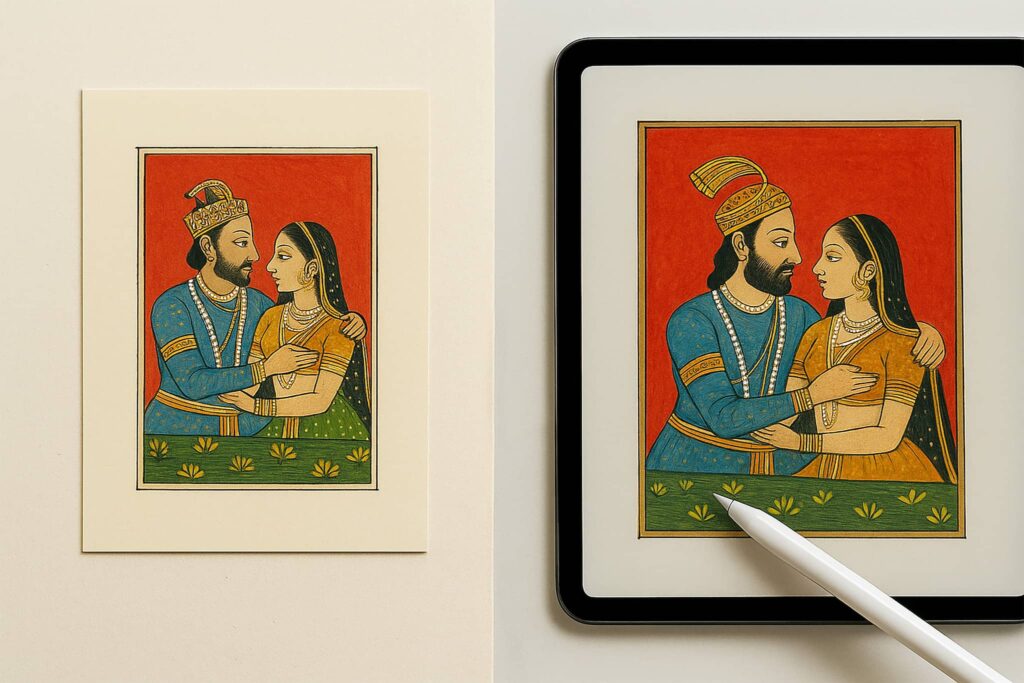
The Indian miniature painting tradition—once confined to palaces, illustrated manuscripts, and the meticulous hands of hereditary painters—is undergoing a digital renaissance. Once fragile, often cloistered, and sometimes inaccessible, these intricate visual documents are now reaching global audiences through high-resolution digital reproductions, online exhibitions, and even NFT experiments.
Across schools—Mughal, Rajasthani, Pahari, and Deccani—the digital turn has played a pivotal role in art preservation, education, and engagement. Institutions like the Salar Jung Museum, the Chhatrapati Shivaji Maharaj Vastu Sangrahalaya (CSMVS), and the National Museum, New Delhi have digitized key holdings, making them available through virtual galleries and open-access initiatives. The CSMVS’s collaboration with Google Arts & Culture, for instance, has brought several hundred miniature paintings online in high-definition, enabling unprecedented close-up study.
This isn’t merely convenience—it’s reclamation. For decades, colonial-era dispersals of Indian miniatures to museums in London, Paris, and Boston had distanced these works from Indian audiences. Today, digital archives allow both scholars and laypeople to reconnect with their visual heritage. In a sense, art appreciation has been democratized without compromising scholarship.
One sentence cannot capture the quiet revolution sparked by scanning a centuries-old Pahari Krishna Leela onto a screen with pixel-perfect clarity.
That said, the digital shift is not without nuance. Texture, pigment depth, scale, and physicality are often lost in translation. A miniature’s gouache brilliance, the shimmer of crushed gems, or the tactile tension of handmade wasli paper cannot be wholly conveyed online. But that limitation is not a failure—it is a call to deeper engagement.
Contemporary artists have responded with intelligence and play. Manisha Gera Baswani, for instance, embeds miniature iconography in abstract works that still echo the lyricism of tradition. Meanwhile, Waswo X. Waswo’s collaborations with traditional painters like R. Vijay bridge miniature aesthetics with contemporary themes—often reproduced as digital prints, postcards, and photobooks, expanding the reach of this idiom into global contemporary art markets.
Art galleries such as Exhibit 320 (New Delhi) and Sakshi Gallery (Mumbai) have also featured reinterpretations of miniature styles, while design houses and decor studios—from Good Earth to independent Etsy stores—have incorporated digital motifs of miniatures into wallpapers, home textiles, and digital art downloads, bringing heritage to domestic space in modern form.
Educationally, schools like The Maharaja Sawai Man Singh II Museum Trust (Jaipur) have launched e-learning platforms where students can study miniature painting techniques through digital modules—helping revive interest in skills once passed down only through apprenticeships.
This movement is not a threat to authenticity but an opportunity for continuity.
As more institutions digitize collections and more creators reinterpret tradition through a digital lens, Indian miniature art is entering a second life—not on walls, but across screens, syllabi, and marketplaces. The visual culture blog is now as critical a space as the gallery.