
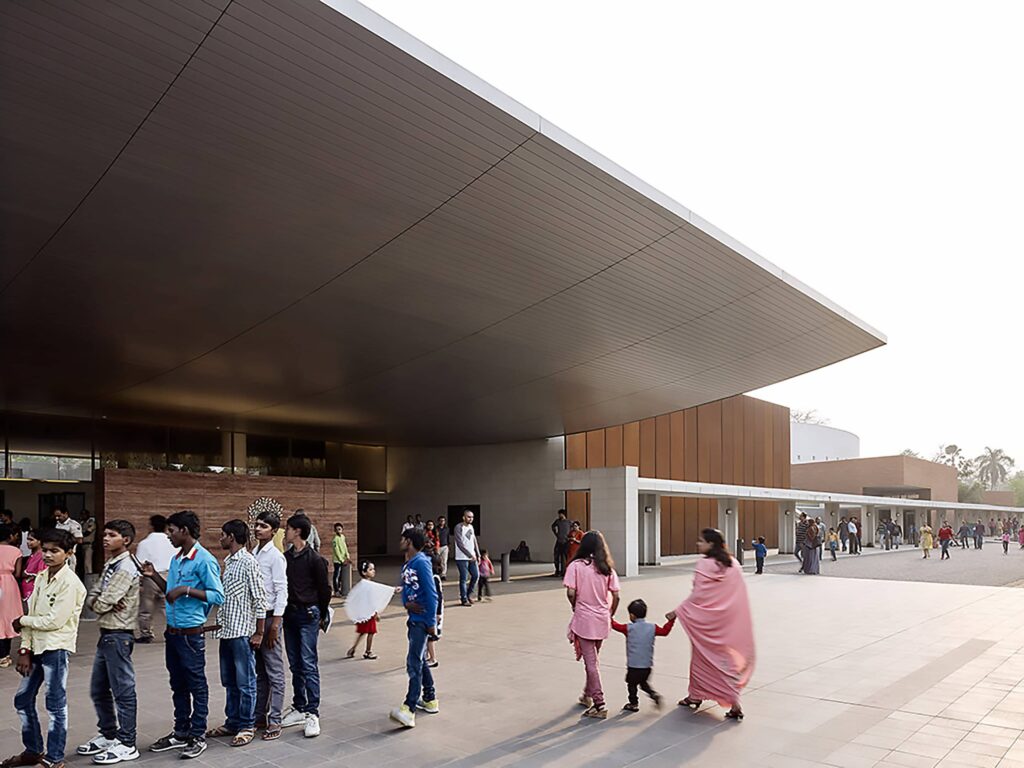
The Bihar Museum in Patna is more than a regional repository—it is a curatorial assertion of Bihar’s long-overlooked contributions to Indian and world heritage, crafted through an ambitious reinterpretation of the state’s art, archaeology, and cultural memory.
Inaugurated in 2017, the museum marks a critical departure from conventional state-run institutions in India, where objects are often catalogued but not contextualized; here, the display narrative is layered, interpretive, and visually coherent. Unlike encyclopedic museums, which overwhelm with inventory, Bihar Museum’s curators have made deliberate editorial choices to ensure that each gallery tells a specific story—rooted in place, time, and continuity. The curatorial strength lies not just in the rare objects on display, but in how they are activated through lighting, spatial design, and historical framing.
Designed by Japanese firm Maki and Associates in collaboration with Indian architect OPOLIS, the building complements the museum’s content through understated, elegant spatial volumes that offer a quiet dignity to Bihar’s cultural resurgence.
One sentence alone can’t capture the significance of the curatorial decision to place a humble terracotta figurine beside a Mauryan stone lion within the same narrative arc of cultural evolution.
The museum’s collection spans the ancient to the contemporary, with particular focus on Bihar’s most significant historical periods:
- Mauryan and Gupta artifacts, including a world-class collection of early Buddhist and Jain sculptures.
- Folk art and tribal traditions of Mithila, Bhagalpur, and Chotanagpur, re-framed as living traditions rather than ethnographic remnants.
- A Children’s Gallery, unique in Indian museums, that uses interactive design to introduce Bihar’s cultural heritage to younger audiences.
- The Contemporary Gallery, featuring modern interpretations of regional iconography, signals an open embrace of continuity rather than static preservation.
Crucially, the museum’s curatorial lens does not fragment history by religion or ruler but presents Bihar’s aesthetic and spiritual plurality—from early Buddhist relics to Islamic calligraphy, from folk votive forms to modernist sculpture—as part of a continuous civilizational fabric.
The Bihar government’s commitment to building and maintaining such an institution is notable in a cultural climate where museums are often seen as secondary to other forms of development, and its investment signals a shift toward recognizing heritage as soft power.
Unlike many state museums that function as time capsules, Bihar Museum positions itself as a dynamic, evolving space where local memory meets global museology.
Through its collections and curatorial intelligence, the Bihar Museum positions the state not as a cultural periphery, but as a central node in India’s artistic and intellectual history, reclaiming narratives long confined to textbooks or neglected corners of major institutions.