
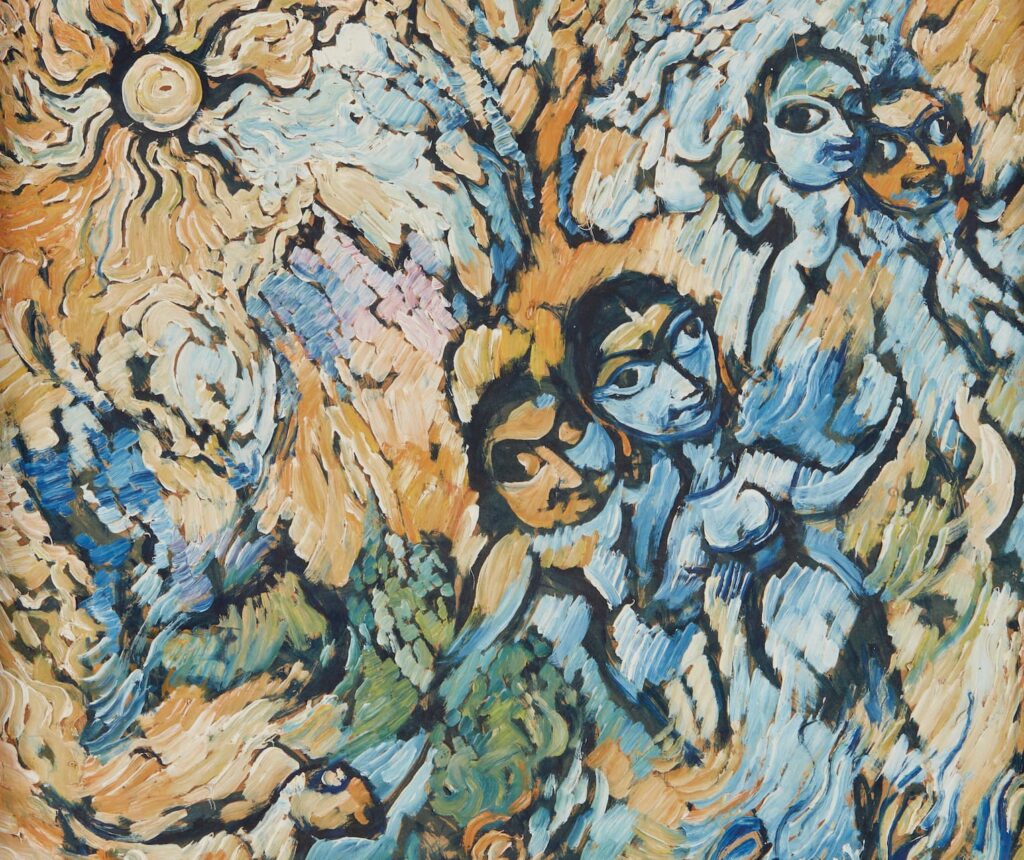
The Madras Art Movement stands as one of the most significant artistic revolutions in post-independence India, yet it remains surprisingly underrecognized on the global stage. Emerging in the 1960s and flourishing through the 1980s, this movement represented a profound shift in Indian artistic expression, blending traditional South Indian aesthetic sensibilities with modernist approaches.
Origins and Foundation
The movement took root at the Government College of Fine Arts in Madras (now Chennai), spearheaded by visionary artists like K.C.S. Paniker. Paniker, who became the college’s principal in 1957, recognized that Indian art needed to forge its own path rather than simply mimic Western modernism. This understanding became the philosophical cornerstone of the movement.
What distinguished the Madras Art Movement was its deliberate effort to create a visual language that was simultaneously modern and authentically Indian. This wasn’t merely artistic nationalism; it was a thoughtful reconciliation between tradition and innovation, between local identity and universal expression.
Key Characteristics and Innovations
Several distinctive features characterized the artwork produced during this period:
- Indigenous Symbolism: Artists incorporated tantric symbols, Tamil script, and folk motifs, creating a visual vocabulary deeply rooted in South Indian cultural heritage.
- Abstract Narrative: While embracing abstraction, the artists didn’t abandon narrative altogether—they transformed it, creating what Paniker called “words and places,” where text and symbolic elements carried cultural significance.
- Material Experimentation: The movement saw extensive experimentation with materials and techniques, including the innovative use of dyes, handmade paper, and unconventional surfaces.
- Metaphysical Concerns: Many works explored spiritual and philosophical questions through abstract forms, reflecting India’s rich contemplative traditions.
Key Figures
Beyond Paniker, several artists made significant contributions to the movement:
- S. Dhanapal: Known for his innovative sculptures that merged modernist simplification with classical Indian sculptural traditions.
- Alphonso Doss: Created powerful works that often incorporated Christian imagery while maintaining a distinctly Indian aesthetic.
- V. Viswanadhan: Explored geometric abstraction infused with tantric symbolism and later gained international recognition.
- C. Douglas: Developed a highly personal visual language dealing with existential themes through haunting imagery and text fragments.
- P. Gopinath: Known for his striking abstractions that often featured calligraphic elements reminiscent of ancient Tamil scripts.
The Cholamandal Artists’ Village
A crucial development in the movement was the establishment of the Cholamandal Artists’ Village in 1966. Located outside Madras, this was India’s first artist-run collective and self-supporting artists’ community. The village provided a collaborative environment where artists could work, live, and exhibit together.
Cholamandal became not just a physical space but an ideological one—embodying the movement’s principles of artistic independence, cultural rootedness, and communal creativity. Today, it continues to function as a living museum and active artists’ community.
Global Context and Legacy
The Madras Art Movement emerged during a period when many postcolonial nations were grappling with questions of cultural identity and artistic direction. Similar to movements like the Casablanca School in Morocco or the Zaria Art Society in Nigeria, the Madras artists sought to decolonize their artistic practice while engaging with global modernism.
The movement’s legacy extends beyond the artworks themselves. It fundamentally altered the trajectory of Indian art by:
- Establishing a modern artistic identity not centered on Delhi or Mumbai
- Creating sustainable models for artist communities
- Developing pedagogical approaches that valued indigenous knowledge
- Expanding the material and technical vocabulary of Indian art
Contemporary Relevance
Today, the Madras Art Movement offers valuable insights for contemporary artists navigating globalization and cultural identity. Its emphasis on finding modernity within tradition rather than in opposition to it remains particularly relevant.
The movement’s artists demonstrated that regional cultural specificity need not limit universal appeal—rather, authentic engagement with one’s cultural roots can lead to art with profound human resonance. As the art world increasingly recognizes the importance of diverse modernities, the Madras Art Movement stands as a pioneering example of cultural synthesis and artistic innovation.
In a globalized art world still struggling with questions of cultural appropriation and authentic expression, the Madras Art Movement provides a model of how artists can engage with both global currents and local traditions to create work that is neither derivative nor insular, but genuinely transformative.
For those interested in exploring the Madras Art Movement firsthand, the Cholamandal Artists’ Village Museum houses an extensive collection of works, while institutions like the National Gallery of Modern Art (Chennai branch) and the Government Museum Chennai also feature significant pieces from this pivotal artistic period.
References:
Google Arts & Culture https://artsandculture.google.com/story/the-madras-movement-cholamandal-artists-village/TAVhqrFDV67NJA
The Routledge Encyclopedia of Modernism https://www.rem.routledge.com/articles/the-madras-art-movement-1960s-1980s
MAP Academy https://mapacademy.io/article/madras-art-movement/
Making Madras Modern: Rediscovering the legacy of K.C.S. Paniker https://dagworld.com/making-madras-modern-rediscovering-the-legacy-of-k-c-s-paniker.html
A Critical Survey of the Madras Art Movement [1950s to 2000] https://aaa.org.hk/en/collections/search/library/a-critical-survey-of-the-madras-art-movement-1950s-to-2000-including-the-madras-school-of-arts-and-crafts
Sahapedia / Madras Art Movement https://www.sahapedia.org/tag/madras-art-movement
Hello, this is a nice place 🙂
Superb article. How did you get the idea for it?